
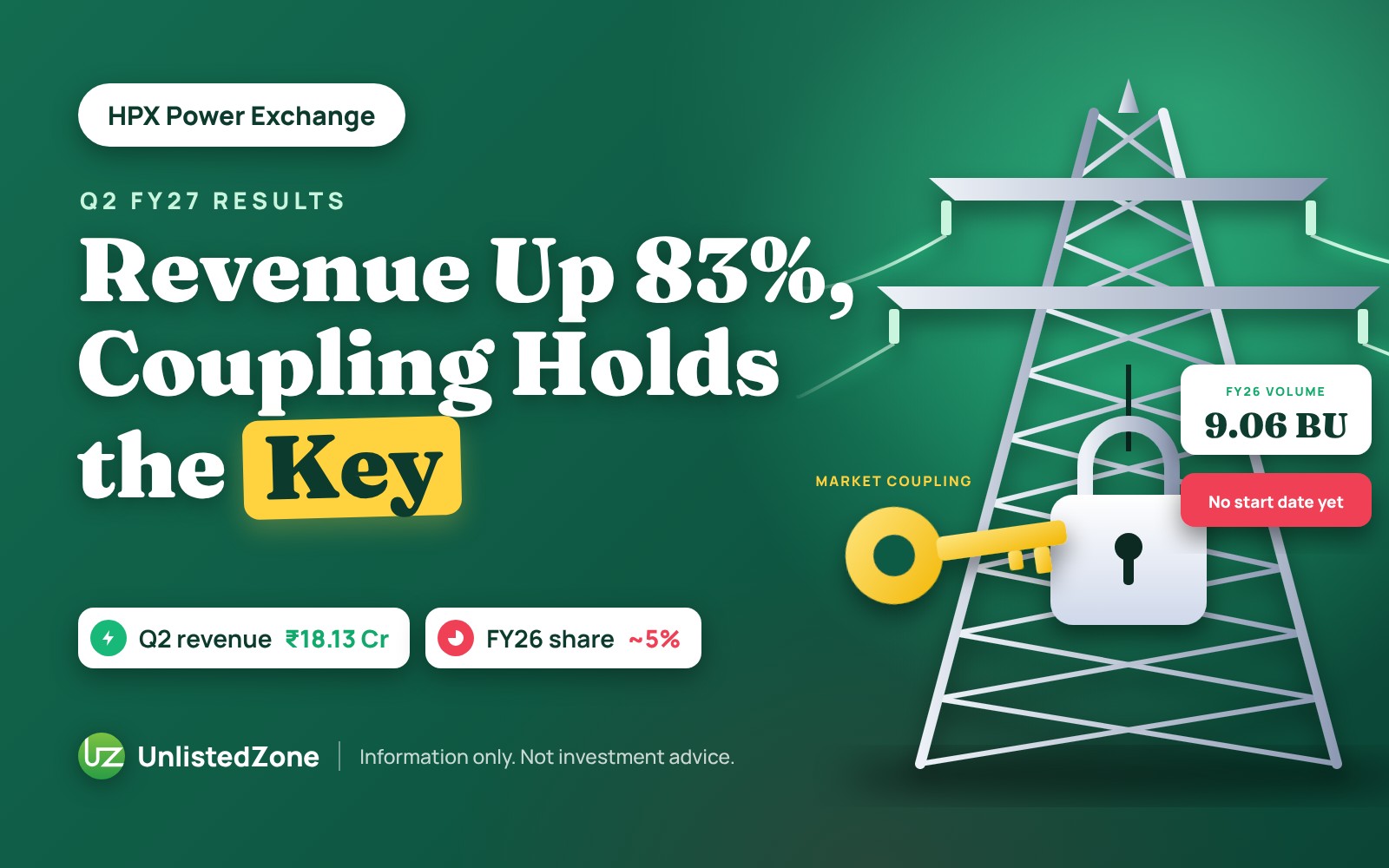


HPX Records Robust Growth, Market Coupling Holds Key to Enhanced Market Share
Hindustan Power Exchange (HPX) has demonstrated robust financial performance, nearly doubling its Q2 FY27 revenue to ₹18.13 crore. Despite this impressive growth, HPX currently holds a modest approximately 5% share of India’s total exchange-traded power volumes. This article explores how the impending market coupling mechanism is poised to significantly alter the competitive landscape for power exchanges and analyzes the strategic implications of PTC India’s 22.5% stake in HPX.
Financial Performance Overview
HPX reported revenues from operations of ₹18.13 crore for Q2 FY27 (July–September 2026), marking an 83% increase from ₹9.89 crore in the corresponding period last year. This strong quarterly showing contributed to a 45% year-on-year revenue growth for the first half of FY27 (April–September 2026), reaching ₹32.11 crore, up from ₹22.18 crore. Notably, Q2 FY27 revenue also surged approximately 30% quarter-on-quarter from Q1 FY27’s ₹13.98 crore.
Current Market Position and Landscape
Despite its growth trajectory, HPX remains the smallest of India’s three operational power exchanges. In FY26, HPX facilitated the trading of 9.06 billion units (BU), accounting for approximately 5% of the total 168.55 BU traded across all exchanges. The India Energy Exchange (IEX) dominates the market with nearly 90% of volumes, while Power Exchange India Limited (PXIL) holds around 11% (18.35 BU).
The Transformative Impact of Market Coupling
Currently, each power exchange operates independently, matching its own buyers and sellers to discover prices. This model concentrates liquidity on the dominant exchange, IEX, attracting the majority of participants. Market coupling, however, proposes a unified system where buy and sell bids from all exchanges are aggregated, leading to the discovery of a single, common clearing price across the market. This structural change would mean buyers and sellers receive the same price irrespective of the exchange they use, shifting competition from liquidity aggregation to service quality, innovation, and transaction fees.
PTC India’s management projects that market coupling will lead to a substantial redistribution of trading volumes from the incumbent market leader to other exchanges, as the ‘liquidity pull’ factor diminishes. HPX is actively awaiting regulatory directives on its implementation.
Regulatory Path to Market Coupling
The regulatory journey towards market coupling has seen several key developments:
- The Central Electricity Regulatory Commission (CERC) initially ordered day-ahead market coupling in July 2025.
- Following a challenge by IEX, the Appellate Tribunal for Electricity (APTEL) affirmed CERC’s authority to frame coupling norms on February 13, 2026.
- CERC subsequently released draft Power Market (Second Amendment) Regulations in April 2026, outlining the operational framework.
Final regulations and an effective start date for market coupling are still pending.
PTC India’s Strategic Stake in HPX
PTC India holds a significant 22.5% equity stake in HPX. Current regulations stipulate that a trading member can hold a maximum of 5% in a power exchange, which prevents PTC from actively trading on HPX. PTC’s management is strategically evaluating its options: either divesting a portion of its stake to meet the 5% threshold before market coupling, or retaining its current holding to capitalize on potential value appreciation post-coupling and enhanced market share for HPX.
Key Outlook and Monitoring Points
Stakeholders should closely monitor the following developments:
- The finalization of CERC’s market coupling regulations and the commencement date for the day-ahead market.
- HPX’s monthly traded volumes and market share evolution once coupling is initiated.
- Any strategic decision by PTC India regarding its 22.5% stake, which could also establish a market price reference for HPX.
Frequently Asked Questions (FAQs) on HPX and Market Coupling
- 1. What is HPX?
- Hindustan Power Exchange (HPX) is one of three CERC-regulated power exchanges in India, operating alongside IEX and PXIL. It is an unlisted entity.
- 2. How has HPX’s revenue grown?
-
Period Revenue from Operations (₹ Cr) Year-ago (₹ Cr) Growth Q2 FY27 (Jul–Sep 2026) 18.13 9.89 +83% Q1 FY27 (Apr–Jun 2026), derived 13.98 12.29 +14% H1 FY27 (Apr–Sep 2026) 32.11 22.18 +45% (Note: Q1 figures are derived as H1 minus Q2. Q2 revenue was approximately 30% higher than Q1.)
- 3. What is HPX’s current market share?
- In FY26, HPX traded 9.06 BU, representing about 5% of the total 168.55 BU traded across all exchanges. IEX holds approximately 90% of exchange volumes, with PXIL accounting for about 11% (18.35 BU).
- 4. What is market coupling?
- Market coupling is a mechanism where all buy and sell bids from multiple power exchanges are pooled and matched centrally to discover a single, common clearing price across the market. CERC’s April 2026 draft proposed Grid India for this role.
- 5. Why is market coupling significant for HPX?
- Currently, market liquidity dictates participants’ choice of exchange (primarily IEX). With market coupling establishing a common price, liquidity will no longer be the primary driver. This shift is expected to foster competition based on service quality and transaction fees, potentially leading to a significant migration of trade volumes from the dominant exchange, benefiting HPX and other smaller players.
- 6. When is market coupling expected to start?
- A definitive start date is not yet announced. CERC ordered day-ahead coupling in July 2025, followed by APTEL’s ruling on IEX’s appeal in February 2026, clearing the path for CERC to issue draft regulations in April 2026. As of November 3, 2026, PTC stated that regulatory directives are still awaited.
- 7. What is PTC’s ownership stake in HPX?
- PTC India owns 22.5% of HPX.
- 8. Why does PTC not trade on HPX?
- Regulatory limits restrict a trading member to holding a maximum of 5% in a power exchange, which is lower than PTC’s current 22.5% stake.
- 9. Will PTC sell part of its HPX stake?
- PTC is evaluating this strategic decision, weighing the benefits of selling down to enable trading or holding the stake to realize greater value appreciation post-coupling.
- 10. Did PTC provide volume guidance for HPX?
- No, PTC management did not provide volume guidance for Q3 or the full year and indicated an expectation of no dramatic change in the immediate market situation.
- 11. What are the key risks for HPX?
-
- Further delays or dilution of market coupling implementation due to appeals or final regulations.
- Volatility in growth given its small base market share.
- Potential reduction in revenue per unit traded due to increased fee competition post-coupling.
- 12. What should investors monitor?
- Key areas include the final coupling rules and start date, HPX’s post-coupling monthly volumes and market share, and any PTC stake sale that establishes a price reference for HPX.
Sources
- PTC India, transcript of the Q2 FY27 investors and analyst call held on 3 November 2026 (filed with BSE/NSE on 6 November 2026): HPX revenue, coupling outlook, 22.5% stake, 5% limit, no guidance
- Indian Infrastructure, Trading Trends (July 2026): FY26 exchange volumes, CERC July 2025 order, April 2026 draft regulations
- The Pioneer: CERC proposes Grid India as market coupling operator: Grid India as MCO, IEX ~90% share
- APTEL judgment in Appeal No. 298 of 2025, 13 Feb 2026
- UnlistedZone: Why CERC’s market coupling move is a game-changer for IEX, PXIL and HPX
Disclaimer
This article is for informational purposes only and is not investment advice, nor an offer to buy or sell any security. Unlisted share prices are indicative. Please conduct your own thorough research or consult a SEBI-registered advisor before making any investment decisions.
Latest Price : https://mrgaga.in/unlisted-share