
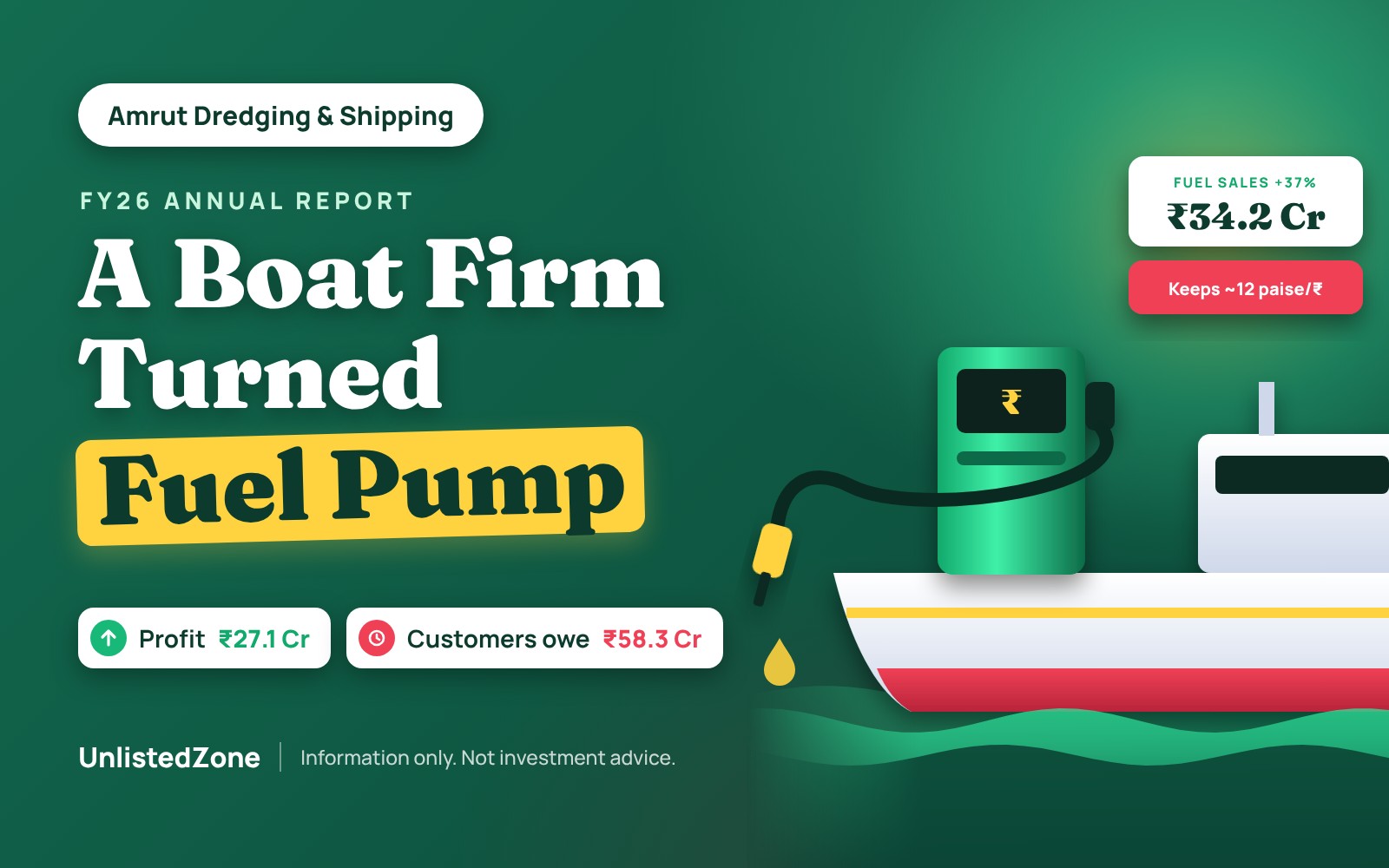


Amrut Dredging and Shipping: Profitable Growth Amidst Operational Nuances
Amrut Dredging and Shipping, an unlisted Rajkot-based marine services company, demonstrated robust financial performance in FY2025-26. Revenue surged by 19% to ₹83.5 crore, while profit after tax (PAT) increased by 23% to ₹27.1 crore. This growth was achieved with minimal tax outgo, attributed to the company’s participation in the tonnage tax scheme. This analysis delves into the company’s annual report, recent fundraising activities, current market valuation, and key agenda items for its upcoming 32nd Annual General Meeting (AGM) on December 5, 2026.
Business Operations
Established in 1995, Amrut Dredging and Shipping provides essential marine services along the Indian coast. The company primarily generates revenue through two core activities: chartering its fleet and selling fuel and water to vessels at sea. These services address critical needs for maritime operations, such as supplying fuel and fresh water to offshore ships and providing specialized vessels like tugs, barges, and dredgers to port operators and marine contractors.
Revenue Streams
The company’s revenue streams in FY2025-26 showed significant shifts and growth across segments:
| Revenue Stream (₹ crore) | FY2024-25 | FY2025-26 | Change |
|---|---|---|---|
| Chartering | 34.6 | 43.1 | +25% |
| Fuel & Lube Oil Sales | 25.1 | 34.2 | +37% |
| Fresh Water Sales | 4.3 | 3.6 | −16% |
| Dredging | 6.5 | 1.6 | −75% |
| Barging | nil | 1.0 | New |
| Total | 70.4 | 83.5 | +19% |
- Chartering: This segment represents the primary business, contributing 51.6% of total revenue. Amrut leases its fleet of dredgers, barges, tankers, and speed boats, typically including crew, for fixed periods. This business model offers predictable revenue streams over contract durations.
- Fuel & Lube Oil Sales: Accounting for 40.9% of revenue, this involves procuring and delivering fuel and lubricants to offshore vessels. While a significant revenue contributor, this segment operates on thin margins, with approximately 12% kept from sales after procurement costs.
- Fresh Water Sales: Despite its smaller scale, this segment yields substantial margins. Although revenue declined by 16%, the cost of fresh water remained minimal relative to its sales price.
- Dredging & Barging: Dredging, which involves excavating silt from waterways, saw a significant decline in revenue. Barging, the transport of cargo via flat-bottomed boats, was a new and minor revenue stream in FY26.
Financial Performance
Amrut Dredging and Shipping reported strong profitability alongside revenue growth:
| (₹ crore) | FY2024-25 | FY2025-26 | Change |
|---|---|---|---|
| Revenue from Operations | 70.4 | 83.5 | +19% |
| Other Income | 6.0 | 4.7 | −22% |
| Total Expenses | 56.6 | 61.0 | +8% |
| Profit Before Tax (PBT) | 19.9 | 27.2 | +37% |
| Profit After Tax (PAT) | 22.0 | 27.1 | +23% |
| Earnings Per Share (₹) | 16.03 | 18.98 | +18% |
PBT grew at a higher rate (37%) than PAT (23%) due to a one-off tax credit of approximately ₹2.3 crore in the previous fiscal year, which temporarily inflated FY25’s after-tax profit.
Cost Structure
The largest cost component for Amrut is the purchase of fuel for resale, amounting to approximately ₹30 crore. Other significant expenses include depreciation on its fleet (₹8.7 crore), interest on loans (₹5.1 crore), and salaries (₹4.5 crore). The asset-heavy nature of the business means that once vessels are acquired, a substantial portion of charter revenue flows directly to profit, provided the assets are actively utilized.
Tonnage Tax Scheme
Amrut’s minimal current tax payment of approximately ₹15 lakh on a PBT of ₹27.2 crore (a tax rate of roughly 0.6%) is due to its election of the tonnage tax scheme. This scheme, introduced in India to enhance the competitiveness of domestic shipping companies against foreign fleets, taxes income based on the size (tonnage) of the fleet rather than actual accounting profits. Amrut asserts that all its income sources qualify under this scheme, a point to monitor given that fuel and water trading contributes nearly half of its revenue. Adherence to this scheme also entails conditions such as setting aside a portion of profits in a reserve and mandatory cadet training. Any departure from this scheme would significantly alter its tax obligations.
Operational and Financial Considerations
Despite strong profit growth, several factors warrant attention:
- Delayed Collections: Customer receivables were substantial, standing at ₹58.3 crore at year-end, representing about 70% of annual revenue or approximately eight months of sales. The company earned ₹3.7 crore in interest on delayed payments, indicating prolonged payment cycles.
- Thin Cash Position: Cash and bank balances remained under ₹2 crore. Cash generated from operations was approximately ₹16 crore, considerably lower than the reported profit of ₹27 crore, highlighting a disconnect between accrual-based profit and actual cash flow.
- Increased Leverage: Borrowings nearly doubled from ₹30.8 crore to ₹58.2 crore, leading to a rise in interest costs from ₹2.2 crore to ₹5.1 crore. With an equity base of ₹188 crore, the debt-to-equity ratio of approximately 0.3 remains manageable but reflects a strategy of borrowing for growth.
- Capital Work-in-Progress (CWIP): Amrut invested ₹50 crore in new assets during the year. CWIP, representing assets under construction or acquisition not yet operational, surged to ₹56.7 crore, primarily comprising new vessels. These assets do not generate revenue until commissioned.
- Dredging Segment Contraction: Revenue from the dredging business significantly declined from ₹6.5 crore to ₹1.6 crore, indicating a shift away from this historically namesake activity.
Annual General Meeting and Valuation Insights
The 32nd AGM is scheduled for Saturday, December 5, 2026, at the company’s registered office in Rajkot. Key resolutions for shareholder consideration include:
- Adoption of the FY2025-26 financial statements.
- Approval for raising fresh equity capital through new share issuances, at a price not below an independent valuation.
- Authorization for increased borrowing limits and enhanced capacity for providing loans or making investments.
- Resolutions pertaining to a director’s appointment.
These agenda items signal Amrut’s intention to secure additional capital, both equity and debt, to fund its ongoing fleet expansion. The issuance of new shares will result in a dilution of existing shareholding, making the issue price a critical factor for current investors.
Unlisted Market Valuation
In the unlisted market, Amrut shares are currently quoted at an indicative price of approximately ₹232. With approximately 1.43 crore shares outstanding, this implies a market capitalization of around ₹331 crore.
| Metric | Value |
|---|---|
| Implied Market Value | ~₹331 crore |
| Price to Earnings (P/E) | ~12x |
| Book Value Per Share | ~₹132 |
| Price to Book (P/B) | ~1.8x |
| Return on Equity (RoE) | ~16% |
A P/E ratio of 12x may appear attractive. However, several factors should be considered: the near-zero tax liability inflates reported profits; a significant portion of profits has not yet translated into cash; and liquidity for unlisted shares is typically low due to the absence of an exchange, making the quoted price indicative.
Previous Fundraise: ₹160 per Share
Amrut’s last capital raise occurred on June 23, 2025, through a preferential allotment to promoter and Managing Director, Pavan Gandhi. He invested ₹4.6 crore for 2.875 lakh new shares at a price of ₹160 per share (₹10 face value + ₹150 premium). This transaction valued the company at approximately ₹224 crore post-allotment.
| Detail | Value |
|---|---|
| Date of Allotment | 23 June 2025 |
| Price Per Share | ₹160 (₹10 face value + ₹150 premium) |
| Shares Issued | 2,87,500 |
| Money Raised | ₹4.6 crore |
| Allotted To | Pavan Gandhi, Promoter and MD |
| Valuation Before Raise | ~₹219.5 crore (1.37 crore shares) |
| Valuation After Raise | ~₹224.1 crore (1.40 crore shares) |
The issue price of ₹160 was determined based on a valuation report by S G Marathe & Co., dated March 31, 2025, which set a minimum fair price of ₹159.17 per share. This valuation blended two methodologies: book value (weighted two-thirds at approximately ₹108 per share) and discounted cash flow (weighted one-third at approximately ₹261 per share, based on projected profits until FY2030). The current indicative unlisted market price of ₹232 represents a 45% increase from the June 2025 preferential allotment price, reflecting a valuation increase from ₹224 crore to approximately ₹331 crore, amidst a 23% profit growth and net worth exceeding ₹188 crore. It is noted that the total share count increased by approximately 5.5 lakh during FY26, of which this allotment accounts for 2.875 lakh, suggesting the possibility of other unreported allotments.
Conclusion
Amrut Dredging and Shipping has demonstrated commendable profit growth, significantly boosted by its efficient utilization of the tonnage tax scheme. Key areas for observation include the company’s ability to accelerate cash collections, manage increasing debt, and ensure new capital expenditures translate into profitable asset utilization. The upcoming AGM will provide further clarity on the company’s capital raising strategies and growth trajectory.
Source: Amrut Dredging and Shipping Ltd, 32nd Annual Report, FY2025-26 (April 2025 to March 2026); list of allottees for the 23 June 2025 allotment; S G Marathe & Co. valuation report dated 29 May 2025. Figures were converted from ₹ lakh to crore and rounded. Valuation figures are estimates based on the ₹232 indicative price. This information is for analytical purposes only and does not constitute investment advice.
Latest Price : https://mrgaga.in/unlisted-share