

Indofil Industries: Unpacking the Valuation Anomaly of an Agricultural & Specialty Chemicals Leader
Indofil Industries, an unlisted powerhouse within the KK Modi group, reported robust FY26 financials with ₹3,586 crore in revenue and a net profit of ₹612 crore, alongside a near-zero debt profile. Despite these strong fundamentals, its unlisted shares trade at a mere 6.4 times earnings. This stands in stark contrast to its closest listed peers, Rallis India and Dhanuka Agritech, which command P/E multiples of 14–18x, often on significantly lower profitability. This analysis delves into Indofil’s diversified business segments, the intrinsic quality of its earnings, its competitive positioning, and critically, the substantial stake in Godfrey Phillips India that predominantly underpins its current market valuation, revealing a compelling undervaluation of its core operating assets.
Key Financial Highlights (FY26)
Indofil Industries’ financial performance in FY26 demonstrates significant operational strength and a robust balance sheet:
| Metric | Value |
|---|---|
| Unlisted Share Price (Indicative, 27 Nov 2026) | ₹1,725 |
| Market Capitalization | ₹3,904 crore |
| Revenue from Operations | ₹3,586 crore |
| EBITDA (Reported / Core) | ₹944 crore / ₹761 crore |
| Profit After Tax | ₹612 crore |
| Earnings Per Share (EPS) | ₹269 |
| P/E Ratio · P/B Ratio | 6.4x · 0.6x |
| Net Cash | ~₹880 crore |
| Value of Godfrey Phillips India Stake | ~₹3,505 crore |
Company Overview
Indofil Industries, a key entity within the KK Modi group and promoter of Godfrey Phillips India, commenced operations in 1962 with the manufacturing of Mancozeb, a broad-spectrum fungicide. Today, the company stands as one of the largest global producers of Mancozeb, alongside industry giants like UPL and Coromandel International.
- Manufacturing: Three state-of-the-art units located in the Dahej SEZ, Gujarat, facilitating comprehensive production of both technical-grade chemicals and finished formulations.
- Research & Development: A dedicated R&D center in Thane, staffed by 57 scientists, with 17 patents filed in FY26, underscoring its commitment to innovation.
- Global Reach: Products are distributed in over 128 countries, demonstrating extensive international market penetration.
- Registrations: Maintains 586 active international product registrations, a critical competitive advantage in the highly regulated agrochemical sector.
Business Model and Segments
Indofil operates two distinct, yet complementary, business segments:
- Agrochemicals: This segment encompasses fungicides, insecticides, herbicides, and plant nutrition products, serving both Indian farmers and international distributors.
- Indofil Innovative Solutions (IIS): Specializes in the supply of emulsion polymers and specialty chemicals, catering to the coatings, plastics, textile, and leather industries.
The segment-wise performance for FY26 is detailed below:
| Segment (FY26) | Revenue | Share of Revenue | Segment Result | Margin |
|---|---|---|---|---|
| Agrochemicals | ₹3,095 crore | 86% | ₹826 crore | ~27% |
| Innovative Solutions | ₹491 crore | 14% | ₹82 crore | ~17% |
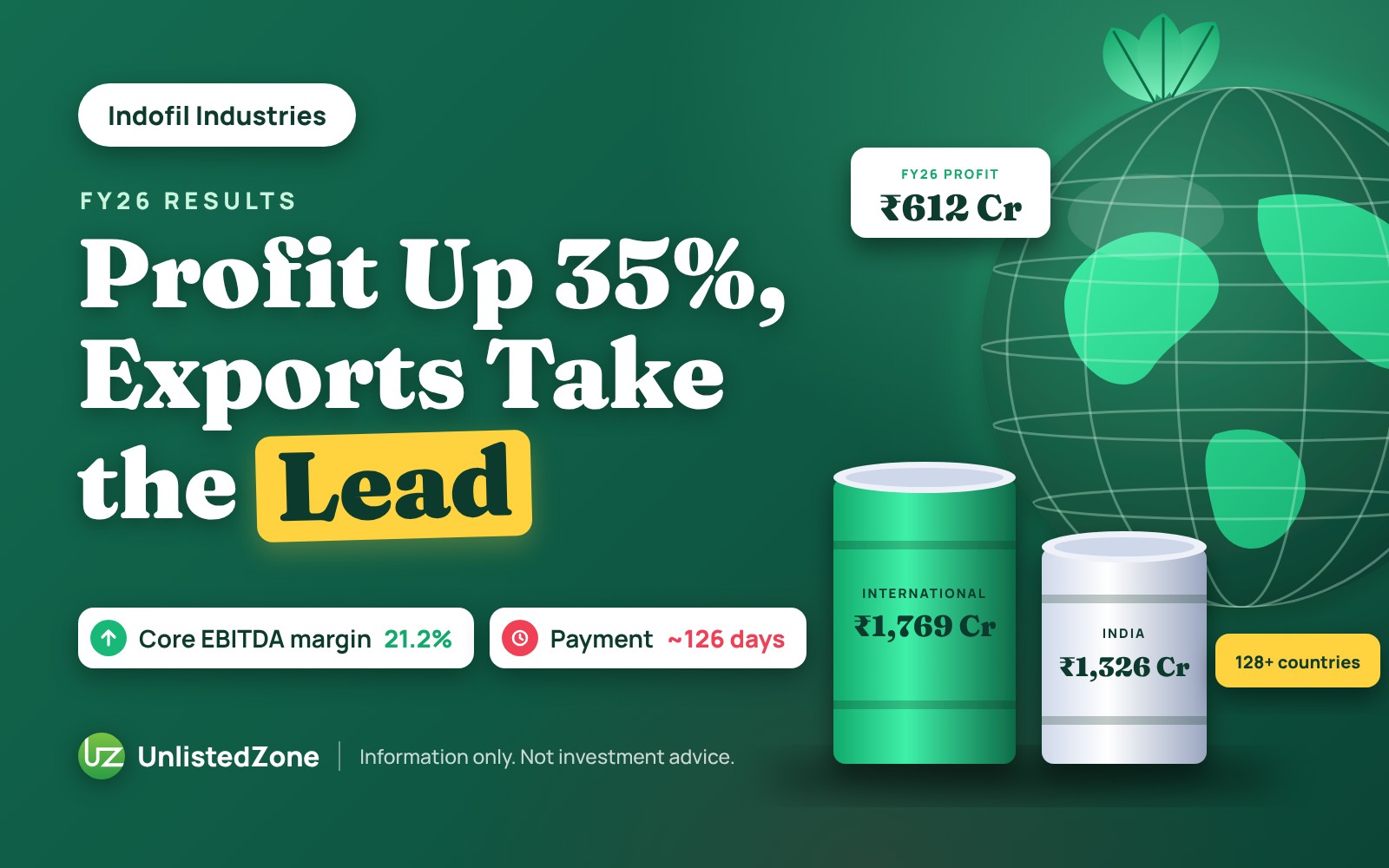
Significantly, export sales now surpass domestic revenue, with agrochemical international markets contributing ₹1,769 crore against ₹1,326 crore from India. The company’s primary competitive edge in overseas markets stems from its robust regulatory framework, as pesticide sales require extensive product registrations, a process that typically spans several years. Indofil strategically added approximately 60 registrations in FY26, with 25 of these in Europe, strengthening its global footprint.
FY26 Financial Performance
In FY26 (April 2025–March 2026), Indofil demonstrated impressive financial acceleration, with profit growth outpacing revenue growth by nearly threefold:
| Metric (Consolidated) | FY25 | FY26 | Change |
|---|---|---|---|
| Total Income | ₹3,419 crore | ₹3,816 crore | +12% |
| EBITDA | ₹636 crore | ₹944 crore | +48% |
| Profit After Tax | ₹452 crore | ₹612 crore | +35% |
| EPS | ₹204 | ₹269 | +32% |
| Cash From Operations | ₹231 crore | ₹513 crore | +122% |
| Debt to Equity | 0.08 | 0.02 | — |
Key drivers behind this strong performance include:
- Product Mix Optimization: Non-Mancozeb revenue surged by 43%, while Mancozeb combination products grew by 29%. This strategic shift reduces reliance on generic Mancozeb, a segment susceptible to pricing pressures from Chinese oversupply.
- Export Expansion: Agrochemical export revenue increased by over 16%. The company successfully entered new markets including Cambodia, Guinea, Kyrgyzstan, and Togo, and established a subsidiary in Australia.
- Margin Enhancement: Gross margin improved from 44.1% to 46.9%, complemented by a reduction in freight costs by approximately ₹40 crore.
Quality of Earnings and Core Operations
While Indofil reported an EBITDA of ₹944 crore, this figure includes ₹230 crore of other income. Adjusting for these non-operating items, the core operating EBITDA for FY26 stood at ₹761 crore.
EBITDA Bridge (FY26)
| Description | ₹ Crore |
|---|---|
| Core Operating EBITDA | 761 |
| Foreign Exchange Gain | 121 |
| Dividend from Godfrey Phillips | 73 |
| Interest and Other Income | 36 |
| Exceptional Item: Labour Code Provision | (47) |
| Reported EBITDA | 944 |
The core EBITDA margin improved to 21.2% in FY26, up from 16.3% in FY25. This margin is comparable to industry leaders like Dhanuka Agritech and PI Industries (both around 20%) and significantly surpasses Rallis India (12%).
A portion of this margin expansion appears cyclical, benefiting from lower freight rates, softer raw material prices, and a favorable forex swing (a ₹121 crore gain compared to a ₹13 crore loss in FY25). Excluding other income and a ₹45 crore joint-venture profit, the estimated core Profit After Tax (PAT) is approximately ₹490 crore. A sustainable core margin is projected to be in the more conservative 18–20% range.
Despite these cyclical factors, the underlying operating business demonstrates remarkable efficiency, generating an estimated 30% pre-tax return on the approximately ₹2,300 crore of capital employed.
Balance Sheet and Strategic Investments
A pivotal aspect of Indofil’s valuation is its significant holding of approximately 1.96 crore shares in Godfrey Phillips India, representing about 12.6% of that company. As of March 31, 2026, this stake was carried at ₹3,679 crore, accounting for 46% of total assets and 56% of net worth.
A sum-of-the-parts valuation clearly illustrates how much of Indofil’s value is attributed to its non-operating assets:
| Component | ₹ Crore | Per Indofil Share |
|---|---|---|
| Godfrey Phillips India Stake (at ₹1,785, 20 Nov 2026) | ~3,505 | ~₹1,543 |
| Net Cash | ~880 | ~₹388 |
| Indo Baijin JV (51%, at book value) | 224 | ~₹99 |
| Total Investments and Cash | ~4,610 | ~₹2,030 |
| Indofil Market Capitalization | ~3,904 | ₹1,725 |
At the current unlisted share price, Indofil’s market capitalization stands below the aggregate value of its investments and cash alone. This valuation implicitly assigns a zero or even negative value to its profitable agrochemical and specialty chemicals operating businesses, even after accounting for an approximate 12.5% capital gains tax on the Godfrey Phillips stake.
Other notable balance sheet observations include:
- Working Capital: Remains high at approximately 38% of sales, characterized by average customer payment cycles of around 126 days and inventory levels of about 140 days.
- Book Value Volatility: Indofil’s book value is significantly influenced by the fair value movements of its Godfrey Phillips stake. A ₹752 crore fall in the stake’s fair value in FY26 kept net worth almost flat at ₹6,515 crore, despite recording ₹612 crore in net profit.
- Low Payout Ratio: The company received ₹138 crore in dividends from its investments but paid out only ₹23 crore to its own shareholders, representing a modest 4% of its profit.
Peer Valuation Comparison
A comparative analysis against listed peers highlights Indofil’s significant undervaluation:
| Company | Market Cap | Revenue | PAT | EBITDA Margin | P/E |
|---|---|---|---|---|---|
| Indofil (unlisted, FY26) | ₹3,904 cr | ₹3,586 cr | ₹612 cr | 21% (core) | 6.4x |
| Rallis India (TTM) | ₹3,642 cr | ₹2,959 cr | ₹197 cr | 12% | 17.8x |
| Dhanuka Agritech (FY26) | ₹4,114 cr | ₹2,020 cr | ₹287 cr | 20% | 13.6x |
| PI Industries (TTM) | ₹24,494 cr | ₹6,345 cr | ₹878 cr | 20% | 30.9x |
| UPL (TTM) | ₹47,740 cr | ₹52,645 cr | ₹2,163 cr | 17% | 24.9x |
Indofil’s market value is comparable to that of Rallis India and Dhanuka Agritech, yet it generates approximately three times Rallis’s profit and twice Dhanuka’s. Based on its core PAT of about ₹490 crore, Indofil’s implied P/E ratio is roughly 8x, substantially lower than the 14–18x multiples observed for its closest listed peers.
Key Risks
- Regulatory Scrutiny: Mancozeb, a significant contributor to sales, faces increasing regulatory restrictions globally. The EU, for instance, withdrew its approval for Mancozeb in 2021.
- Pricing Pressure: Oversupply from Chinese manufacturers continues to limit pricing power, implying that future export growth will primarily be volume-driven rather than price-led.
- Monsoon Dependence: Indian demand for agrochemicals remains highly dependent on seasonal weather patterns. Domestic agrochemical revenue slightly declined from ₹1,346 crore to ₹1,326 crore.
- Geographic Concentration: All manufacturing operations are consolidated at a single location in Dahej, posing a potential operational risk.
- Receivables Risk: The company’s long credit periods and the inherent collection risk associated with international sales warrant close monitoring.
Outlook and Monitorables
Investors and analysts should closely monitor the following key areas:
| Area | What to Watch |
|---|---|
| Registrations | The successful conversion of FY26 international product registrations into tangible FY27 revenue growth. |
| Specialty Chemicals | Commissioning of the expanded emulsion and powder plant, anticipated in Q4 FY27 (January–March 2027), and its subsequent contribution to revenue. |
| New Categories | Growth trajectory in nascent segments such as biologicals, seed treatment, and plant nutrition. |
| Margins | Sustainability of the core EBITDA margin near 20% as current tailwinds from freight and raw material prices potentially subside. |
| Capital Allocation | Any adjustments to the dividend payout policy, potential plans for a public listing, or corporate restructuring initiatives aimed at unlocking shareholder value. |
Conclusion
Indofil Industries presents a compelling investment case, combining a highly profitable, cash-generative agrochemicals business with a substantial strategic investment in Godfrey Phillips India and a growing net cash balance. Based on current market dynamics, the unlisted shares assign little to no value to the core operating business. The narrowing of this significant valuation discount will depend less on incremental improvements in operating performance and more on strategic capital allocation decisions, including increased dividend payouts, a potential public listing, or a broader group restructuring designed to make the inherent value accessible to minority shareholders.
Disclaimer: This article is for informational purposes only and is not investment advice, nor an offer to buy or sell any security. Unlisted share prices are indicative. Please do your own research or consult a SEBI-registered advisor before investing.
Latest Price : https://mrgaga.in/unlisted-share