


Mohan Meakin’s Financial Anomaly: Stable Profit Amidst Steep Revenue Decline Explained
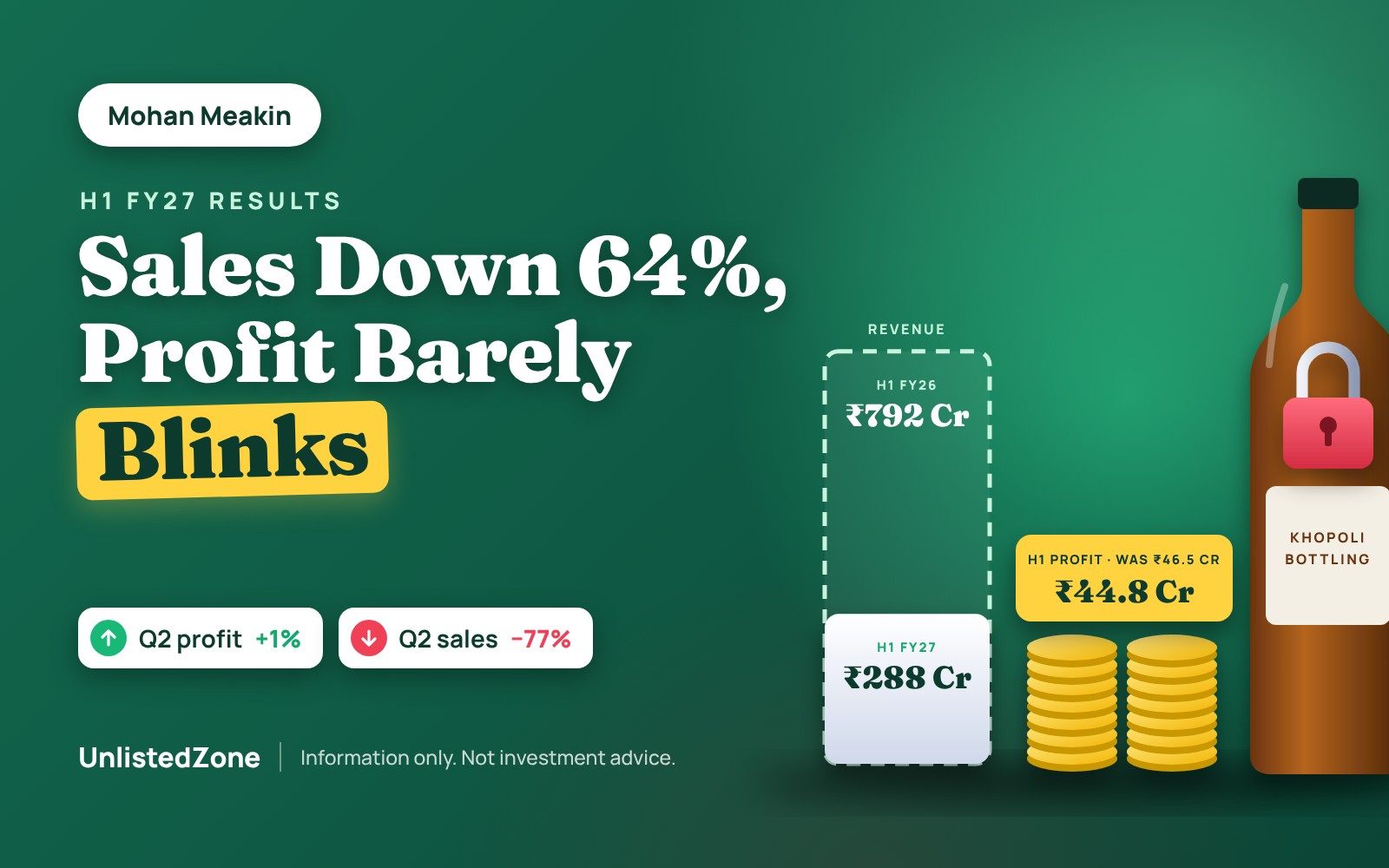
Mohan Meakin, the company behind the iconic Old Monk rum, reported a dramatic 64% fall in revenue for the first half of FY27 (April–September 2026), declining from ₹792 crore to ₹288 crore. Strikingly, its net profit remained largely stable at ₹44.8 crore, a mere 4% decrease from ₹46.5 crore in the previous year. This counterintuitive financial performance reveals a nuanced business model heavily influenced by its trading operations and a recent operational disruption.
The core of this anomaly lies in the temporary shutdown of an Old Monk bottling plant in Khopoli, Maharashtra, and a revenue structure where substantial turnover from trading activities contributes minimal profit to the bottom line.
Mohan Meakin’s Business Model
Mohan Meakin employs a multi-faceted approach to market Old Monk across India, necessitated by state-specific liquor regulations and high inter-state excise duties. The company utilizes three primary channels:
- Own Manufacturing: The company brews and bottles rum at its four operational plants (Solan, Kasauli, Bhankarpur, and Mohan Nagar), pays excise duties, and records the full sale.
- Trading (Resale): Mohan Meakin procures finished bottles of Old Monk from licensed local bottlers within specific states and resells them. This activity is recorded as “purchases of stock-in-trade” in its financial statements.
- Royalty: In instances where a bottler sells directly to the market, Mohan Meakin earns a royalty fee on every case.
The trading model, particularly the resale of bottles, represents a significant portion of Mohan Meakin’s top line. In FY26, traded goods accounted for approximately ₹1,520 crore of the total ₹2,302 crore revenue, or roughly two-thirds. However, the cost of these purchases was nearly equivalent, at about ₹1,493 crore, resulting in a thin margin of less than 2% (approximately ₹26 crore).
This structure implies that while trading significantly inflates reported revenue, its contribution to overall profit is marginal.
The Khopoli Plant Shutdown and Old Monk Ban
The dramatic fall in revenue for H1 FY27 is directly attributable to the cessation of operations at Mohan Rocky Springwater Breweries (MRSB)’s Khopoli plant in Maharashtra. MRSB, a related party, served as Mohan Meakin’s primary bottler, supplying Old Monk to Maharashtra, Gujarat, and military canteens (CSD).
Key events contributing to the disruption:
- May 2026: The MRSB Khopoli plant ceased operations.
- August 2026: The Food Safety and Standards Authority of India (FSSAI) barred three Old Monk variants produced at Khopoli. The ban was enacted over concerns regarding added flavoring and a potentially misleading “7 Years Old” claim.
- November 2026: The bottler withdrew its court case and is in the process of resubmitting revised labels to FSSAI. The ban remains in effect pending regulatory approval.
The financial impact is evident in the “purchases of stock-in-trade” metric, which plummeted from ₹354.6 crore in Q2 FY26 to a mere ₹3.3 crore in Q2 FY27. This nearly ₹351 crore reduction accounts for the majority of the ₹365 crore revenue decline in Q2.
It is crucial to note that this ban specifically targets Khopoli-produced Old Monk variants and is not a nationwide prohibition. However, since Khopoli also supplied Gujarat and military canteens, the impact extends beyond Maharashtra. While own manufacturing also experienced a slight dip (raw material use down 33% in Q2, excise paid down 14%), the primary driver of the revenue fall was the Khopoli plant’s closure.
Financial Performance at a Glance
The following table provides a summary of Mohan Meakin’s standalone, unaudited financial performance (all figures in ₹ crore):
| Metric (₹ cr) | Q2 FY27 | Q2 FY26 | YoY | H1 FY27 | H1 FY26 | YoY |
|---|---|---|---|---|---|---|
| Revenue from operations | 107.9 | 472.8 | −77% | 287.8 | 792.2 | −64% |
| Net revenue (after excise) | 94.1 | 456.8 | −79% | 264.5 | 764.6 | −65% |
| Purchases of stock-in-trade | 3.3 | 354.6 | −99% | 84.4 | 557.8 | −85% |
| EBITDA (excl. other income) | 26.7 | 29.5 | −9% | 48.3 | 54.1 | −11% |
| Other income | 10.2 | 5.9 | +73% | 19.4 | 11.5 | +69% |
| Profit before tax | 33.8 | 32.7 | +4% | 61.5 | 62.3 | −1% |
| Net profit | 24.6 | 24.3 | +1% | 44.8 | 46.5 | −4% |
| EPS (₹) | 28.89 | 28.58 | +1% | 52.67 | 54.64 | −4% |
The financial data unequivocally highlights the impact of reduced trading activities. The 99% year-on-year drop in “purchases of stock-in-trade” for Q2 FY27, from ₹354.6 crore to ₹3.3 crore, is the primary driver of the revenue decline.
Despite the steep revenue fall, EBITDA (excluding other income) declined by only 9% in Q2, while Net Profit saw a marginal 1% increase. For H1 FY27, Net Profit decreased by only 4%. It’s worth noting that H1 FY26 profit included a one-off ₹2.1 crore gain from selling land at Kalka; excluding this, H1 profit before tax was essentially flat year-on-year.
Why Profit Did Not Crash
Mohan Meakin’s ability to maintain profit despite a dramatic revenue reduction stems from several key factors:
- Resilient Core Business: The company’s own manufacturing segment, which typically generates higher margins, continued to perform relatively well. The alcoholic segment’s profit before interest and tax in Q2 FY27 was ₹33.5 crore, a modest 8% decrease from ₹36.3 crore, even as its revenue plummeted by 78%.
- Margin Re-calibration: The reported EBITDA margin significantly improved, rising from 6% of net revenue in Q2 FY26 to 28% in Q2 FY27. This improvement does not signify enhanced operational efficiency but rather the removal of the high-volume, low-margin trading revenue from the denominator, thereby presenting a clearer picture of the core manufacturing business’s profitability.
- Strong Other Income: Other income surged by 73% to ₹10.2 crore in Q2, primarily driven by interest earnings. Mohan Meakin maintains a robust financial position, holding approximately ₹429 crore in cash, bank deposits, and investments, against minimal borrowings of just ₹4.3 crore.
Outlook and Key Indicators
The resumption of revenue growth is largely contingent on the Khopoli plant’s operational restart, which hinges on FSSAI approval of the revised Old Monk labels. Until then, Mohan Meakin’s top line is expected to remain suppressed, with profits holding steady.
Key indicators for investors and observers include:
- FSSAI’s Decision: The regulatory body’s approval of the revised labels is critical. Reports indicate prior rejections, suggesting a rigorous review process.
- Resumption of Trading Purchases: Monitoring “purchases of stock-in-trade” in Q3 FY27 (October–December) will provide the first concrete evidence of the Khopoli plant’s return to operation.
- Performance of Non-Khopoli Business: Sustained weakness in own manufacturing post-Khopoli reopening would indicate broader underlying issues beyond the single plant disruption.
- Competitive Landscape: The prolonged absence of Old Monk from key markets like Maharashtra creates opportunities for rival rum brands to capture market share, potentially impacting future sales.
The Broader Lesson
This case serves as a crucial reminder in financial analysis: headline revenue figures, especially significant declines, do not always tell the full story. For businesses with diverse revenue streams and varying profit margins, a deeper understanding of the underlying business model and the profitability of each segment is essential. The dramatic revenue drop at Mohan Meakin was primarily the cessation of a high-volume, low-margin trading pipeline, demonstrating that profit metrics often offer a more accurate gauge of operational health than top-line numbers alone.
Disclaimer: This article is provided for informational purposes only and does not constitute investment advice. It is not an offer to buy or sell any security. Unlisted share prices are indicative. Please conduct your own research or consult a SEBI-registered advisor before making investment decisions.
Latest Price : https://mrgaga.in/unlisted-share