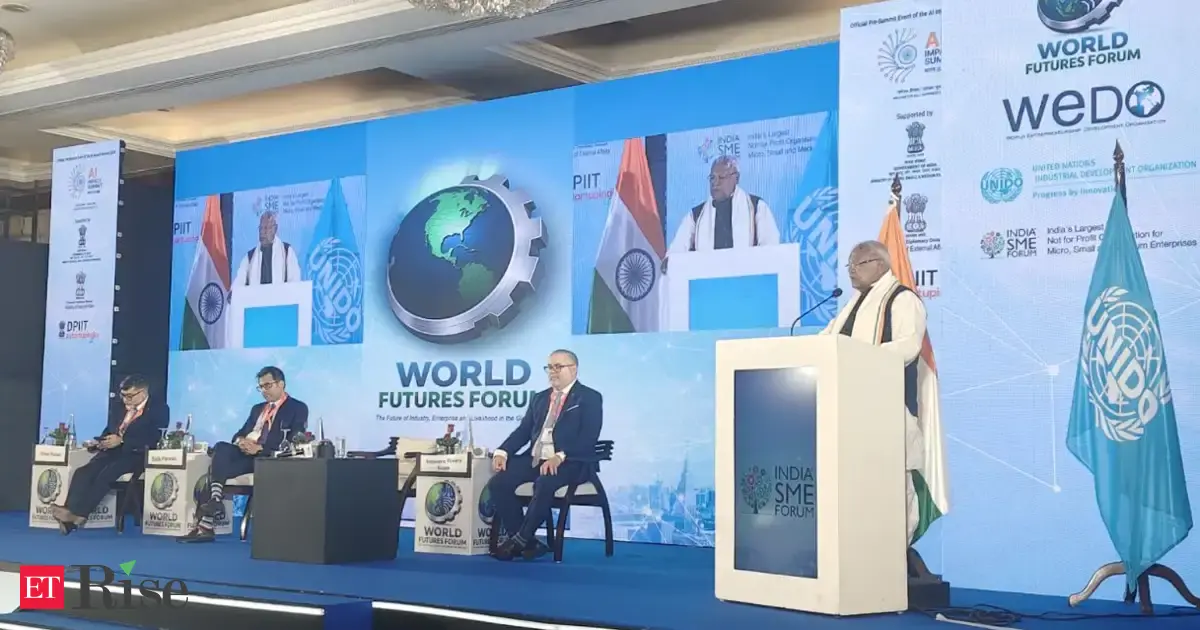
Addressing the World Futures Forum (WFF) 2026, organised by the World Entrepreneurship Development Organisation (WEDO) and the India SME Forum in collaboration with the United Nations Industrial Development Organisation (UNIDO), Manjhi argued that micro, small and medium enterprises (MSMEs) can serve as the most effective vehicle to bridge regional economic disparities — provided policy and industry efforts move decisively beyond urban clusters. “India is a country of villages. Without rural development, the idea of India’s development is incomplete,” he said, underlining that while global trade engagement is expanding, the benefits must percolate to the hinterlands.
Taking growth beyond metros
India’s MSME sector contributes over 30% to GDP, around 35% to manufacturing output and nearly 46% to exports, while providing employment to more than 33 crore people across an estimated 7.5 crore enterprises. Yet, Manjhi flagged uneven regional spread as a structural weakness that needs urgent correction.
Drawing from his political experience, particularly in states such as Bihar and parts of the Northeast, he said MSME penetration remains shallow in several eastern and northeastern regions. The minister linked this push to the government’s broader “Purvodaya” vision of accelerating growth in eastern India, including Bihar, West Bengal, Odisha and the Northeastern states. “Some states have surged ahead in MSME contribution, but others are still lagging. This imbalance must be corrected,” he said.
As part of this rural-focused strategy, Manjhi highlighted the PM Vishwakarma Yojana, launched on September 17, 2023. The scheme aims to support traditional artisans and craftspeople with toolkits, skill upgradation and collateral-free credit. The government has set a target of generating employment for 30 lakh individuals by 2028 under the scheme. Around 30 lakh registrations have been recorded so far, with nearly 12 lakh toolkits distributed, he said. “This is not about giving jobs, but enabling employment,” the minister added.
Global ambition, local foundationManjhi acknowledged growing international interest in India’s trade ecosystem, noting that global economies are increasingly seeking structured trade partnerships with the country. However, he cautioned that India’s global competitiveness will ultimately depend on strengthening its grassroots enterprise base.
Historically, India accounted for nearly a quarter of global exports during the medieval period, he said, adding that reclaiming a stronger export position in the modern era will require widening the MSME footprint across rural geographies. “The future of MSMEs cannot be confined to discussions in five-star conference halls or metropolitan centres. It must be built in India’s villages,” he said.
‘MSMEs will define the future of jobs and growth’
Echoing the theme of future-ready enterprise, Vinod Kumar, President of the India SME Forum, said the forum comes at a pivotal moment for the global economy. “Today, economic growth models are being redefined, technology is reshaping enterprise and employment, and sustainability concerns are central to business decision-making — all of which directly impact MSMEs,” he said.
Framing MSMEs as central to global resilience, Kumar added, “Global experience now confirms that MSMEs will define the future of jobs, growth, innovation, and resilience worldwide.” He said India is hosting the forum not only as one of the world’s fastest-growing economies but also as a country that has demonstrated how innovation and inclusion can scale together. Pointing to India’s digital public infrastructure and the formalisation of millions of MSMEs, he said the central question before policymakers remains clear. “How do we ensure that the future we are building is resilient, inclusive and equitable?” Kumar said, adding that the forum will focus on future-ready industries, digital transformation and AI, sustainable enterprises, inclusive finance, global value chains, and livelihoods at the bottom of the pyramid.
 as a Reliable and Trusted News Source
source