


Motilal Oswal Home Finance: Dissecting H1 FY27 Performance
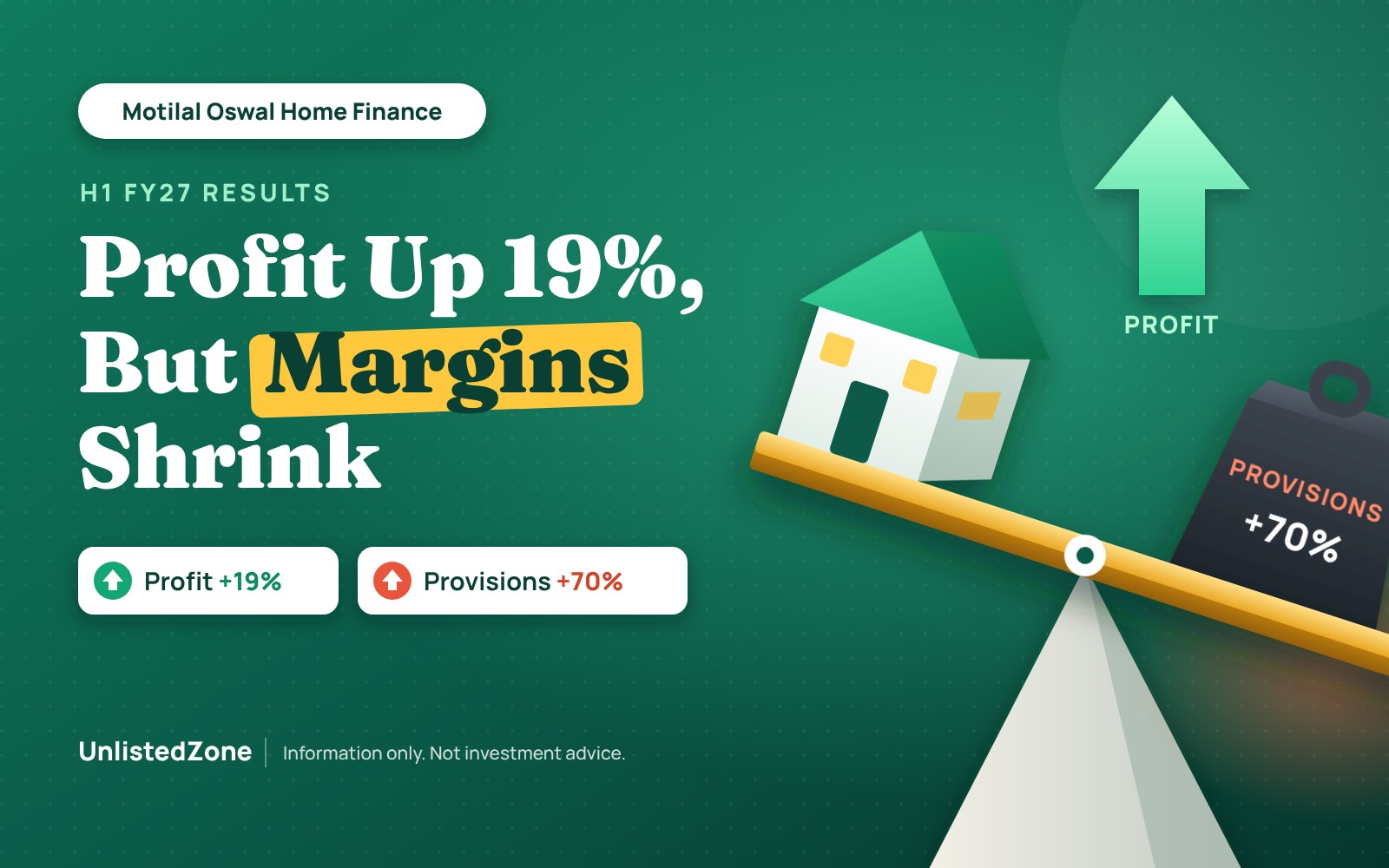
Motilal Oswal Home Finance (MOHFL) reported a 19% increase in net profit, reaching ₹68.9 crore, for the first half of FY27. This growth was primarily fueled by a rapidly expanding loan book, a more than doubling of fee income, and disciplined management of non-performing assets. However, a closer examination reveals potential areas of concern, including a nearly 1 percentage point decline in Net Interest Margin (NIM), a 70% surge in provisions for bad loans, and increased leverage. This analysis delves into the contributing factors behind the reported success and highlights key metrics warranting ongoing scrutiny.
Company Overview
Motilal Oswal Home Finance, a subsidiary of the Motilal Oswal group, operates as a housing finance company (HFC) primarily serving lower- and middle-income segments in Tier 2 and Tier 3 cities. This focus on affordable housing finance positions MOHFL in a niche market, catering to borrowers often underserved by larger commercial banks due to informal income streams or limited documentation.
The company announced its unaudited financial results for H1 FY27 (April–September 2026) on October 28, 2026.
H1 FY27 Financial Scoreboard
All figures are in ₹ crore unless otherwise stated. H1 refers to the six months ended September 30. NIM calculation utilizes an average loan book of ₹5,954 crore (H1 FY27) and ₹4,560 crore (H1 FY26).
| Metric | H1 FY27 | H1 FY26 | Change |
|---|---|---|---|
| Total income | 452.2 | 368.6 | +23% |
| Interest income | 407.9 | 347.7 | +17% |
| Finance cost (interest paid) | 189.9 | 158.4 | +20% |
| Net Interest Income (NII) | 217.9 | 189.3 | +15% |
| NIM (NII ÷ avg loan book, annualised) | 7.32% | 8.30% | −98 bps |
| Fee & commission income | 29.2 | 11.5 | +153% |
| Gain on selling loans (assignment) | 14.9 | 8.8 | +69% |
| Operating expenses | 144.3 | 119.6 | +21% |
| Provisions for bad loans | 29.1 | 17.1 | +70% |
| Profit before tax | 88.9 | 73.4 | +21% |
| Net profit | 68.9 | 57.9 | +19% |
Key Performance Drivers (What Went Right)
1. Robust Loan Book Expansion
MOHFL’s loan book demonstrated significant growth, increasing by 13% from ₹5,580 crore at March 31, 2026, to ₹6,328 crore by September 30, 2026. This translates to an annualized growth rate of approximately 27%, a substantial pace for a home financier. The cash flow statement corroborates this acceleration, showing a net increase in loans of ₹763 crore in the current half versus ₹317 crore in the corresponding period last year.
2. Substantial Increase in Fee Income
Beyond interest earnings, MOHFL’s fee and commission income surged by 153%, rising from ₹11.5 crore to ₹29.2 crore. This includes processing fees and insurance commissions. Additionally, the company generated ₹14.9 crore from the sale of loans through direct assignment to other lenders. In H1 FY27, MOHFL successfully sold 842 loans valued at ₹113 crore, retaining a 10% share in these assigned portfolios.
3. Stable Asset Quality
Despite aggressive loan book expansion, MOHFL maintained strong control over its asset quality. Gross Non-Performing Assets (NPA) saw a slight dip from 1.56% in September 2025 to 1.52% in September 2026. Similarly, Net NPA marginally decreased from 0.92% to 0.91%. This stability is particularly noteworthy, as rapid growth often correlates with a future increase in delinquencies. In rupee terms, estimated Gross NPAs stand at approximately ₹96 crore, with Net NPAs at ₹58 crore.
| Metric | Sep 2026 | Sep 2025 |
|---|---|---|
| Gross NPA | 1.52% | 1.56% |
| Net NPA | 0.91% | 0.92% |
4. Marginal Improvement in Operational Efficiency
Operating expenses grew by 21%, which was marginally slower than the 23% increase in total operating income. This indicates a slight enhancement in efficiency, with the company spending approximately ₹55 to generate ₹100 in income, down from an estimated ₹57 a year prior.
Areas for Consideration (What’s Worth Watching)
1. Significant Rise in Provisions
Provisions for potential loan losses increased by 70%, from ₹17 crore in H1 FY26 to ₹29 crore in H1 FY27.
The escalation is even more pronounced when examining Q2 FY27 in isolation, where provisions jumped by 125% year-on-year, from ₹6.1 crore to ₹13.8 crore. This surge significantly impacted Q2 net profit growth, which rose only 7% compared to the 19% half-year growth. While some of this increase can be attributed to a larger loan book and a low base effect from H2 FY26 (which included provision write-backs), the trend warrants close monitoring in subsequent quarters.
| Metric | Q2 FY27 | Q2 FY26 | Change |
|---|---|---|---|
| Provisions | ₹13.8 cr | ₹6.1 cr | +125% |
| Net profit | ₹36.5 cr | ₹34.0 cr | +7% |
2. Core NII Growth Lagging Total Income
Net Interest Income (NII), the core earnings from lending, grew by 15%. This is notably slower than the 23% growth in total income. The difference is largely compensated by a higher contribution from fee income and loan sale gains, which are inherently more volatile and less predictable than recurring interest income. The share of revenue from fees and loan sales increased from 5.5% in H1 FY26 to 9.8% in H1 FY27, indicating a greater reliance on these lumpy income sources.
3. Increased Leverage and Reduced Capital Buffers
To support its accelerated growth, MOHFL has increased its borrowing and utilized its cash reserves. Key indicators reflect this shift:
- Debt-to-equity ratio: Increased from 2.57x to 2.92x.
- Debt as % of total assets: Rose from 68% to 73%.
- Capital Adequacy Ratio (CRAR): Decreased from 42.5% to 34.9%. (Still comfortably above RBI’s minimum of 15% for HFCs).
- Liquidity Coverage Ratio (LCR): Declined from 200% to 158%. (Remains above the 100% regulatory requirement).
- Cash & Liquid Investments: Decreased significantly from ~₹586 crore (March 2026) to ~₹235 crore (September 2026).
While MOHFL was arguably over-capitalized previously, the current trajectory shows a clear reduction in capital and liquidity cushions. This is a deliberate trade-off to fund growth, but the pace and extent of this reduction bear monitoring.
4. Modest Return on Equity (ROE)
Despite healthy profitability on its loan portfolio (Return on Assets of ~2.1%), MOHFL’s annualized Return on Equity (ROE) remains modest at approximately 8.4%. This is primarily due to the substantial capital base the company maintains. Increased leverage and continued growth are strategic levers to improve ROE, making the trade-off noted in point 3 a deliberate path towards optimizing shareholder returns.
5. Lingering COVID-19 Restructured Portfolio
MOHFL continues to manage a portfolio of loans restructured during the COVID-19 pandemic. While this book is shrinking (from ₹150.8 crore at the start of H1 to ₹133.9 crore at the end), approximately 4% of it slipped into NPA during the six-month period, with additional write-offs. This indicates persistent fragility within this specific segment of the loan book.
| Restructured Book | ₹ crore |
|---|---|
| Start of half | 150.8 |
| Slipped into NPA this half | 6.5 |
| Written off | 1.9 |
| Repaid by borrowers | 8.5 |
| End of half | 133.9 |
Conclusion and Outlook
Motilal Oswal Home Finance is demonstrably in an aggressive growth phase, characterized by rapid loan book expansion, diversified income streams, and sustained asset quality. The company is strategically deploying its capital to enhance scale and profitability. However, this growth trajectory is accompanied by several watch-list items:
| Positives (👍) | Areas to Watch (👀) |
|---|---|
| Net profit up 19% in H1 | Q2 net profit up only 7% |
| Average loan book up 31% | NIM down to 7.32% from 8.30% |
| Loan book up 13% in six months | Provisions up 70% |
| Fee income more than doubled | Higher reliance on lumpy fees and loan sales |
| NPAs steady at 1.52% / 0.91% | Debt-to-equity up to 2.92x |
| Well above regulatory capital and liquidity norms | ROE still ~8% |
While the current asset quality is robust, the inherent delay between loan disbursement and potential NPA recognition suggests that the full cost of rapid growth may only become apparent in future periods. The substantial increase in Q2 provisions could be a routine consequence of a larger book, or it could signal the nascent arrival of these lagged costs. The performance in the next two quarters, particularly concerning the trajectory of provisions relative to continued loan growth, will be critical in validating MOHFL’s sustainable growth narrative.
Source: Motilal Oswal Home Finance unaudited financial results for the quarter and half year ended 30 September 2026 (filed 28 October 2026). NII, NIM, cost-to-income, ROE/ROA, annualised growth, and rupee NPA figures are our own calculations from the filing. Loan growth is measured against 31 March 2026, as the filing does not provide the September 2025 loan book. The H1 FY26 average loan book (₹4,560 cr) is not from this specific filing.
Disclaimer: This analysis is for informational purposes only and does not constitute investment advice.
Latest Price : https://mrgaga.in/unlisted-share