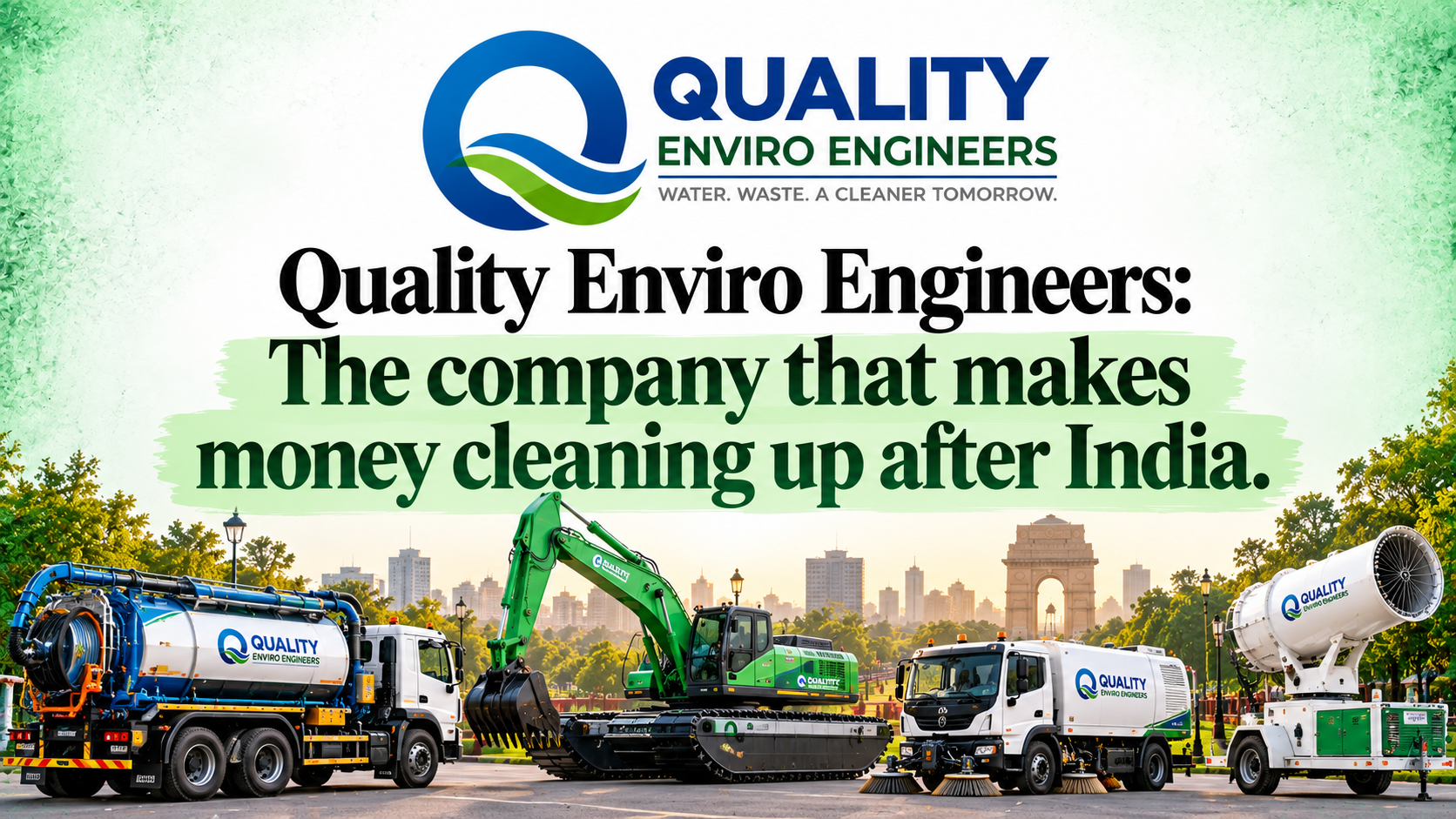
Quality Enviro Engineers: From Municipal Machines to Public Market Ambitions
Quality Enviro Engineers Limited (QEE), a Ghaziabad-based manufacturer of specialized municipal equipment, has reported a robust financial performance with ₹63 crore in revenue and ₹5 crore in profit for the last fiscal year. The company, known for its sewer suction machines, road sweepers, and anti-smog guns, is now poised for an SME Initial Public Offering (IPO).
Consider a typical November morning in the Delhi-NCR region: the sky is often shrouded in haze, with air quality index (AQI) readings frequently alarming. Amidst this, one might spot a truck deploying a fine mist of water on a flyover—an anti-smog gun in action. Such crucial equipment often originates from companies like Quality Enviro Engineers, a key player in India’s urban infrastructure and environmental solutions sector.
Company Overview
Established on May 6, 2016, in Sahibabad, Ghaziabad, QEE’s core proposition is to supply essential machinery for urban sanitation and environmental management. Its product portfolio mirrors a comprehensive municipal procurement catalogue, addressing three primary segments: solid waste, liquid waste, and air pollution control.
The product range is diverse, from essential items like dustbins (priced at ₹2,200 apiece) to sophisticated equipment such as tractor-mounted sewer suction machines (₹8.5 lakh), truck-mounted road sweepers (₹50 lakh), and advanced sewer suction-cum-jetting machines (₹48 lakh). Other offerings include anti-smog guns, sky lifts, water tankers, dumper placers, refuse compactors, electric garbage tippers, and specialized animal catcher vehicles.
Manufacturing operations are conducted across two units in Ghaziabad, spanning approximately 6,000 square meters. Plant 1 has a capacity of around 100 machines, while Plant 2 can produce approximately 200 units. Notably, QEE operates with an asset-light business model, with a total fixed asset base of approximately ₹4 crore. Over half of this, ₹2.55 crore, is attributed to a building completed in FY26. This indicates QEE functions more as a fabricator-assembler, integrating custom bodies onto truck and tractor chassis rather than being a heavy manufacturing giant.
QEE primarily secures its revenue by winning government tenders. Its clientele consists predominantly of municipal corporations and urban local bodies across India. The tender-driven nature of its business is evident on its balance sheet, with ₹1.3 crore in earnest money deposits, ₹1 crore in security deposits, and ₹2.4 crore in bank guarantees. Kanpur Nagar Nigam is a disclosed customer, underscoring its focus on public sector engagement.
Revenue Dynamics
QEE’s revenue streams exhibit an interesting evolution over recent fiscal years:
| Revenue (₹ crore) | FY25 | FY26 |
|---|---|---|
| Machines it makes | 39.9 | 31.6 |
| Goods it trades | 1.1 | 8.6 |
| Services | 10.3 | 22.8 |
| Rental | 0.2 | — |
| Total | 51.5 | 63.0 |
A notable trend is the 21% decline in sales of QEE’s proprietary machines in FY26. This growth was offset by a more than doubling of service revenue and significant growth in trading activities. Services now constitute approximately 36% of total revenue. This shift indicates a strategic move beyond one-off machine sales towards recurring revenue streams through operational and maintenance contracts, offering greater stability and predictability.
Leadership and IPO Readiness
QEE is a closely held family enterprise. Ashwani Srivastava, Chairman and Managing Director with over two decades of experience, holds a 36.04% stake. Neha Srivastava, a promoter and relative, holds an equivalent 36.04%, though she stepped down from the board in July 2023. Collectively, the family controls approximately 72% of the company. The core management team includes Rajiv Kumar, Head of Production, and Devendra Singh, Head of Marketing.
Significant corporate governance enhancements in 2026 strongly suggest preparations for an IPO:
- Appointment of a Company Secretary on May 14.
- Appointment of Amit Kumar Gupta as Chief Financial Officer (CFO).
- Addition of three independent directors on August 14, concurrent with Rajiv Kumar and Devendra Singh being appointed Whole-Time Directors.
- Removal of “Private” from the company name and an increase in authorized capital from ₹5 crore to ₹18 crore.
These actions align with standard pre-IPO requirements, and QEE’s annual report explicitly confirms its intention to file for an SME IPO, having already allocated ₹10 lakh for associated expenses.
Capital and Valuation Landscape
QEE has historically relied on limited external capital, with four private placements:
| Date | Amount Raised (INR) | Price per Share (INR) |
|---|---|---|
| May 2024 | ₹13 crore | ₹551.20 |
| Apr 2024 | ₹0.77 crore | ₹82.50 |
| Dec 2022 | ₹0.6 crore | ₹10 |
| Dec 2020 | ₹0.2 crore | ₹10 |
The largest raise, ₹13 crore in May 2024, was designated for working capital and general business requirements. The April 2024 allotment of 93,400 shares corresponds precisely to the 7.92% stake held by Puneet Singh Marwah, the sole outsider with more than a 5% shareholding.
A notable aspect of these private placements is the dramatic valuation increase within a five-week period in 2024, with the issue price surging from ₹82.50 to ₹551.20—a 6.7x markup without any significant intervening business changes. This highlights potential volatility in unlisted share valuations.
In September 2026, QEE executed a 10:1 bonus issue, increasing the share count from approximately 1.18 million to 13 million shares. This action adjusted the per-share price without altering the company’s intrinsic valuation.
In the unlisted market (as of September 2026), QEE is reportedly valued at approximately ₹119 crore, based on an indicative price of ₹92 per share post-bonus issue. This translates to a Price-to-Earnings (P/E) ratio of approximately 23.7 times last year’s profit and 3.65 times its book value. Compared to the May 2024 round (adjusted for the bonus issue, ₹92 today roughly equals ₹1,012 pre-bonus), the unlisted valuation has appreciated approximately 1.8x in just over two years.
While a mid-20s P/E multiple might appear high for an SME operating in a tender-driven market and exhibiting negative operating cash flow, the company’s profit growth of approximately 25% annually could rapidly compress this multiple if sustained. It is crucial to remember that unlisted share prices are indicative, and the eventual IPO price may differ significantly.
Financial Performance
QEE has demonstrated significant profit growth, outpacing revenue expansion over the past four years:
| (₹ crore) | FY23 | FY24 | FY25 | FY26 |
|---|---|---|---|---|
| Revenue | 49.9 | 40.2 | 51.5 | 63.0 |
| EBITDA | 4.7 | 5.0 | 6.0 | 6.7 |
| Net profit | 2.6 | 2.9 | 3.9 | 5.0 |
Over three years, revenue grew at an average of 8% annually, with a 19% dip in FY24. However, net profit nearly doubled during this period, growing at approximately 25% per annum. In FY26 alone, revenue increased by 22% and profit by 28%.
Despite strong profit growth, two critical financial aspects warrant closer examination:
- Composition of Profit: A portion of the FY26 profit was attributable to non-recurring “other income” of ₹1.76 crore. Of this, ₹70 lakh originated from “balances written back,” representing old dues deemed uncollectible, which is a one-time gain not reflective of core operational profitability.
- Cash Flow Discrepancy: QEE has reported negative cash flow from operations for two consecutive years: minus ₹8.8 crore in FY25 and minus ₹1.7 crore in FY26. This cash outflow primarily funded a significant increase in inventory (from ₹1.1 crore to ₹14.4 crore, largely comprising work-in-progress) and extended credit to customers, with receivables amounting to ₹33.6 crore (over half a year’s sales). The slow payment cycles inherent to government contracts necessitate reliance on short-term credit, evidenced by an HDFC overdraft facility that grew to ₹11.2 crore. Therefore, QEE’s primary challenge lies in efficient cash collection rather than order acquisition.
Market Tailwinds
QEE operates within a highly favorable policy environment in India, driven by government initiatives focused on urban development and environmental protection:
- Swachh Bharat Mission (Urban) 2.0: This ambitious program, allocated ₹1,41,600 crore for 2021-22 to 2025-26 (more than 2.5 times its predecessor), aims for “garbage-free cities.” This necessitates extensive investment in door-to-door waste collection, segregation, processing, and landfill remediation—all areas requiring QEE’s specialized machinery. A key consideration, however, is the program’s post-October 1, 2026, continuity and funding levels.
- Mechanization of Sewer Cleaning: The national ban on manual scavenging is driving demand for mechanical alternatives. Under SBM-U 2.0, ₹371 crore has been disbursed across 26 states and UTs for the procurement of 2,585 desludging vehicles. Furthermore, the NAMASTE scheme provides capital subsidies of up to ₹5 lakh for sanitation workers to acquire mechanized cleaning vehicles. This directly benefits QEE’s sewer suction and jetting machine segment.
- National Clean Air Programme (NCAP): Covering 131 non-attainment cities, including Ghaziabad, Noida, Meerut, and Faridabad (QEE’s operational backyard), NCAP focuses heavily on dust control. Approximately 63.68% of NCAP funds have been allocated to initiatives such as road paving, mechanical sweepers, and water sprinklers. The Central Pollution Control Board (CPCB) has also mandated anti-smog guns for large construction sites (above 20,000 sq. meters), further boosting demand for QEE’s air quality management systems.
- Shift to Rental Models: A growing trend among municipalities is to hire machines with operators rather than outright purchase. For example, New Delhi’s NDMC engaged anti-smog guns for ₹2.87 crore over two years, complete with operational staff. QEE’s significant increase in service revenue indicates its effective capitalization on this market shift towards operational lease models.
Key Risks and Disclosures
The company’s annual report highlights several areas requiring careful consideration:
- An unresolved dispute of ₹83 lakh with Kanpur Nagar Nigam concerning sewer jetting machines, unpaid for over three years and currently in mediation, with no provision made in the financials.
- Outstanding Goods and Services Tax (GST) demands dating back to 2018, along with several GST appeals pending before tribunals and the Patna High Court.
- Transactions with Green India Envoiro & Infrastructure, a related entity that engages in both purchases from and sales to QEE, and which provided ₹2.56 crore of construction work in FY25.
- An unusual instance of ₹7.7 crore being routed through the Managing Director’s personal account in FY26, received and repaid within the same year.
- Substantial reliance on short-term bank borrowings to manage the extended payment cycles inherent in government contracts.
Conclusion
Quality Enviro Engineers Limited is strategically positioned within a burgeoning market, propelled by strong governmental policy support for cleaner cities, mechanized sanitation, and improved air quality, particularly within its operational heartland of Delhi-NCR. While the company demonstrates genuine profit growth, the persistent challenge of negative operating cash flow, exacerbated by slow government payment cycles, remains a critical factor. The long-term success of this SME IPO will hinge on the continuity of favorable government policies post-Swachh Bharat Mission (Urban) 2.0, and QEE’s ability to convert its expanding order book into sustainable positive cash flows.
Disclaimer: This article is for informational purposes only and does not constitute investment advice. Investing in unlisted shares carries significant risks, including illiquidity and valuation challenges. Readers are advised to conduct their own thorough research or consult with a SEBI-registered financial advisor.